Table of Contents
ToggleHomeopathic Medicine Linum Usitatissimum: A Comprehensive Guide
Linum usitatissimum, commonly known as flax or linseed, occupies a unique and somewhat paradoxical position within the homeopathic materia medica. While the plant itself is familiar to most people as a source of fiber, oil, and the traditional poultice used for drawing out inflammation, its homeopathic application derives from a different kind of knowledge—one built upon observations of sensitivity reactions, provings, and the peculiar symptom picture that emerges when the body responds to this seemingly humble seed. The remedy is not among the most frequently prescribed in modern homeopathic practice, yet it retains a distinct place for practitioners who recognize its characteristic patterns, particularly in conditions involving intense irritation of the respiratory passages, skin, and nervous system.
Origin and Botanical Background
Linum usitatissimum belongs to the family Linaceae and is an annual herbaceous plant native to regions of Europe and the Near East, though it has been cultivated worldwide for thousands of years for both its fiber and its seeds . The plant grows to a height of roughly one to three feet, bearing slender stems, narrow lanceolate leaves, and delicate blue or white flowers that give way to small round capsules containing the flattened, oval seeds for which the plant is best known.
The homeopathic remedy is prepared from the whole plant, although the seeds are often the focal point of preparation in many commercial products . This is consistent with the plant’s traditional uses, where the seeds and their mucilaginous properties have been employed both internally and externally. The Latin name itself reflects this dual utility: Linum from the Celtic lin meaning thread, referring to the fibrous stems used in linen production, and usitatissimum meaning “most useful.”
Preparation and Potencies
The homeopathic preparation of Linum usitatissimum typically begins with a mother tincture derived from the seeds or the whole plant material . The seeds are rich in mucilage, fixed oils (particularly alpha-linolenic acid), lignans, and small quantities of cyanogenic glycosides, which may account for some of the remedy’s more dramatic symptom expressions .
The mother tincture serves as the starting point for subsequent dilutions and succussions, following the standard homeopathic method of potentization. Commercially available preparations range from low potencies such as 2CH or 4DH up through higher dilutions including 30CH and 60DH . Linum usitatissimum is also available in various dosage forms including granules, ointments, oral powders, and liquid solutions, reflecting its versatility in clinical application . Some manufacturers combine it with other substances in complex formulations, while others offer it as a single remedy in the classic Hahnemannian tradition.
The Symptom Picture
The homeopathic understanding of Linum usitatissimum rests largely on observations of individuals who have shown marked sensitivity to the plant’s physical form—whether through handling linseed, applying poultices, or inadvertently ingesting the oil. These observations, recorded in classical materia medica texts, reveal a remedy whose action is characterized by intense irritation affecting multiple systems simultaneously .
Respiratory Symptoms
One of the most striking features of the Linum usitatissimum picture is its profound effect on the respiratory system. Exposure to linseed in sensitive individuals has produced symptoms resembling severe bronchial asthma, with extreme difficulty in breathing, a sensation of constriction in the chest, and a feeling of suffocation . The breathing becomes labored, and the individual may appear livid and struggle for air. This respiratory distress is often accompanied by a dry, irritating cough and a sensation of rawness in the air passages. The link between skin eruptions and respiratory complaints is notable in this remedy, mirroring the clinical observation that asthma and eczema frequently alternate or coexist in the same individual .
Skin Manifestations
The skin symptoms of Linum usitatissimum are equally distinctive. The application of linseed poultices has been known to provoke eruptions of urticaria, with large raised wheals that burn, sting, and smart . In some recorded cases, the eruption covered the entire body from the crown of the head to the soles of the feet, producing a sensation described as a complete bodily eruption with intense smarting and burning . A crop of herpes may appear at the site where the poultice was applied, suggesting a localized reaction that can generalize in sensitive subjects .
Nervous System and Spasmodic Symptoms
Perhaps the most dramatic symptom expressions in the Linum usitatissimum record involve the nervous system. A notable case describes a young woman who accidentally consumed linseed oil and immediately experienced a sensation of fullness in the stomach, followed by vomiting and copious stools . She then developed spasms of a peculiar character: her head shook in measured time, the muscles of her temples and eyes jerked rapidly, her jaws became clenched, and her tongue was paralyzed and felt as though it were drawn down into her throat . Throughout the ordeal, her consciousness remained perfectly clear, a detail that underscores the remedy’s affinity for producing motor disturbances without clouding the sensorium. The spasms were severe enough to require the jaws to be pried open, and speech was lost for a period before gradually returning .
This case, preserved in the classical literature, illustrates the intensity of which Linum usitatissimum is capable. The paralysis of the tongue, the spasmodic movements of the head and facial muscles, and the trismus-like clenching of the jaw all point to a profound irritation of the nerve centers, a theme that runs through the remedy’s provings and clinical observations .
Gastrointestinal and Urinary Symptoms
The gastrointestinal effects of Linum usitatissimum are well known even outside homeopathy, as the seeds are used as a bulk-forming laxative. In the homeopathic context, the remedy has been employed for irritation of the digestive tract, with symptoms including a sensation of weight or fullness in the stomach, colic, and alternating patterns of vomiting and diarrhea . The mucilaginous quality of the seeds provides a soothing, demulcent effect on irritated mucous membranes, which may explain its traditional use in gastritis and enteritis .
The urinary passages are also within the sphere of action. The decoction has been noted as serviceable in inflammation of the urinary tract, including cystitis and strangury . This use aligns with the plant’s traditional application as a soothing diuretic and anti-inflammatory agent.
Modalities and Concomitants
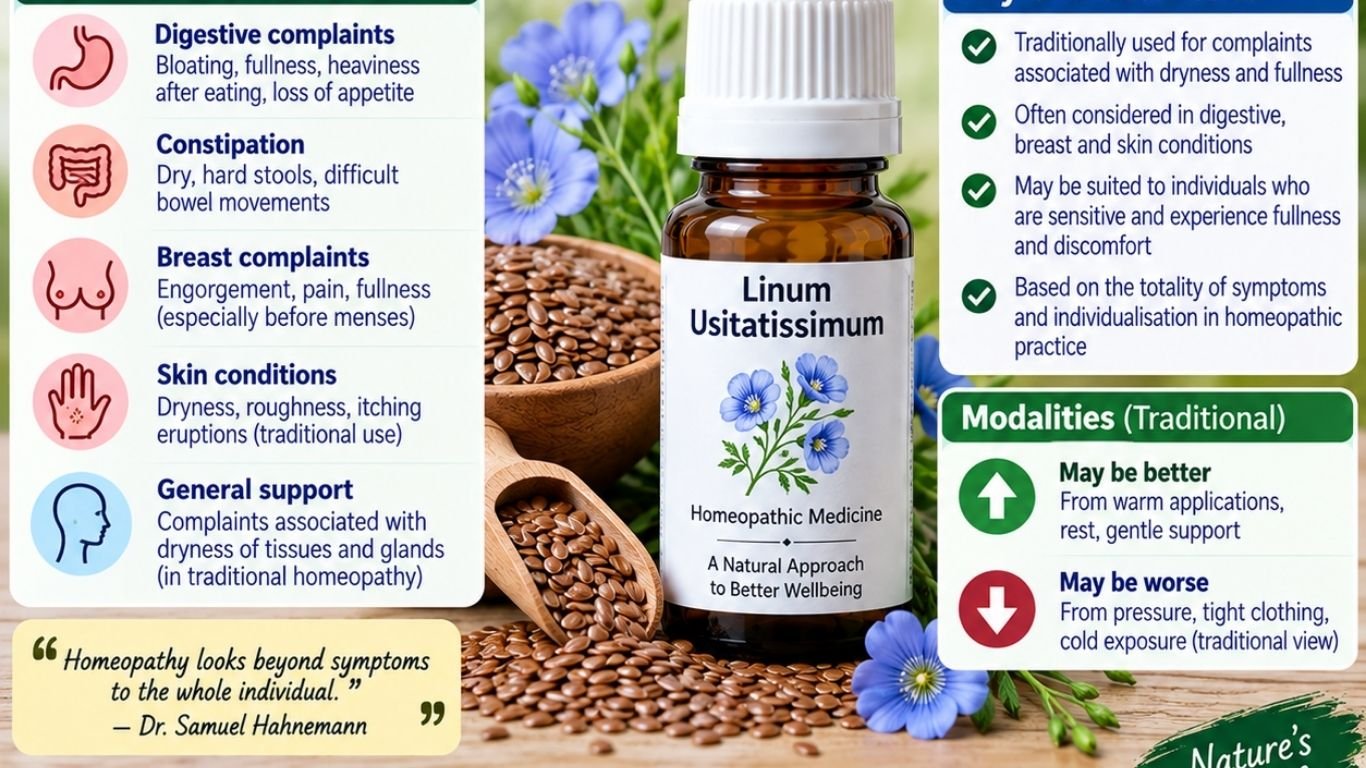
While the classical literature does not provide an extensive repertory of modalities for Linum usitatissimum, certain patterns emerge. The symptoms are generally worse from exposure to the substance itself, whether through contact, inhalation of the dust or steam, or ingestion . The respiratory and skin symptoms appear to be aggravated by dampness and by the application of heat in the form of poultices. The mental state during the severe symptom expressions is one of clear consciousness despite the dramatic physical disturbances, a characteristic that may help differentiate this remedy from others in which confusion or delirium accompanies spasmodic conditions.
Uses in Homeopathic Practice
Given the symptom picture, Linum usitatissimum has found its primary application in conditions characterized by intense irritation of the respiratory passages and skin. It has been used in cases of asthma, particularly where the attacks are accompanied by or alternate with urticarial eruptions . Hay fever with marked irritation of the eyes, nose, and throat may also respond to this remedy, especially when there is a sensation of burning and dryness in the mucous membranes .
In skin conditions, the remedy has been employed for urticaria with intense burning and stinging, and for localized herpetic eruptions that follow contact with the substance . The gastrointestinal uses, while less prominent in the homeopathic literature, include irritation of the digestive tract with colic and alternating diarrhea and constipation.
The remedy is generally indicated in lower potencies, with the third to thirtieth dilutions being most commonly cited . The mother tincture and low potencies are sometimes used for the gastrointestinal and urinary indications, while higher potencies may be selected when the symptom picture is predominantly nervous or respiratory.
Side Effects and Safety Considerations
In homeopathic potencies, Linum usitatissimum is generally regarded as safe when used according to established principles. However, the crude substance—particularly the seeds and oil—carries certain risks that are relevant to understanding the remedy’s action. Whole or unground seeds can swell and potentially cause obstruction if taken without adequate fluid, and the seeds should always be soaked and consumed with a generous amount of liquid . The plant contains small quantities of cyanogenic glycosides, and while single doses of up to 150 to 300 grams of powdered linseed are not considered toxic, excessive consumption is inadvisable .
Linseed has demonstrated estrogenic activity due to its lignan content, and caution is warranted in individuals with hormone-dependent conditions . The mucilaginous properties of the seeds may delay the absorption of other medications taken concurrently, so a gap of at least one hour between Linum usitatissimum and other drugs is recommended . In homeopathic potency, these concerns are largely theoretical, but practitioners should still exercise appropriate caution when recommending the remedy for prolonged periods or in individuals with significant medical histories.
Comparisons with Other Remedies
Understanding Linum usitatissimum in relation to other homeopathic remedies helps to sharpen its characteristic indications. The most frequently cited comparison is with Linum catharticum, commonly known as purging flax. While both share respiratory symptoms, Linum catharticum is more prominently associated with colic and diarrhea, reflecting its traditional use as a purgative .
In the treatment of asthma and skin affections, Linum usitatissimum invites comparison with Arsenicum album, Apis mellifica, and Chloralum . Arsenicum album is indicated when asthma is accompanied by intense restlessness, anxiety, and a burning sensation that is relieved by warmth, whereas Linum usitatissimum presents with a more localized irritation and a spasmodic, jerking quality to the nervous symptoms. Apis mellifica shares the urticarial skin manifestations, but the swelling and stinging of Apis are typically more pronounced, with a characteristic burning and stinging that is relieved by cold applications. Chloralum may be considered when the respiratory distress is accompanied by profound nervous irritation and a sense of suffocation.
Ipecacuanha has been mentioned as a possible antidote to Linum usitatissimum , and the two remedies share certain gastrointestinal indications, though Ipecac is characterized by persistent nausea and a clean tongue, while Linum usitatissimum presents more with a sense of weight and colic.
The spasmodic symptoms of Linum usitatissimum—particularly the trismus-like jaw clenching and tongue paralysis—invite comparison with remedies such as Strychnos nux-vomica and Cicuta virosa. Nux vomica is characterized by spasms and rigidity with extreme irritability and sensitivity to stimuli, while Cicuta has a more profound involvement of the nervous system with convulsions and a characteristic distortion of the body. The key differentiating feature of Linum usitatissimum is the clear consciousness maintained throughout the spasmodic episodes, along with the specific involvement of the tongue and the respiratory distress.
Conclusion
Linum usitatissimum remains a remedy of narrow but distinct application in homeopathic practice. Its symptom picture, derived largely from observations of sensitive individuals and accidental provings, centers on intense irritation of the respiratory and cutaneous surfaces, with the potential for dramatic nervous system involvement in the form of spasms and paralysis. The remedy is not one that will be indicated in a majority of cases, but when the characteristic pattern appears—the asthma with urticaria, the burning and stinging skin eruptions, the peculiar spasmodic movements with clear consciousness—it may prove remarkably effective. As with all homeopathic remedies, its use should be guided by a thorough understanding of the individual’s total symptom picture and a careful assessment of the modalities and concomitant symptoms that point to the simillimum.
The information presented here is drawn from classical homeopathic sources and traditional observations. As with any therapeutic approach, individuals should consult qualified practitioners before using homeopathic remedies, and the material offered in this article is intended for educational purposes rather than as a substitute for professional medical advice.
Frequently Asked Questions About the Homeopathic Medicine Linum Usitatissimum
What is Linum usitatissimum?
Linum usitatissimum is the botanical name for the common flax or linseed plant. In homeopathy, a remedy is prepared from the whole plant or its seeds and then diluted into various potencies.
What is it traditionally used for?
Based on classical records, it has been used after symptoms were observed in sensitive people who came into contact with linseed or linseed poultices. Traditional uses include breathing difficulties such as asthma-like complaints, hives, hay fever, and irritation of the mouth or tongue.
What are the main symptoms associated with it?
The picture is dominated by intense irritation. On the skin, there may be raised hives spreading from head to foot, with burning, stinging and smarting. Breathing can become extremely difficult. Recorded cases also describe clenched jaws, jerking head movements and a paralyzed tongue, while consciousness stays completely clear.
What potencies are available?
Common forms include the mother tincture, liquid dilutions such as 12CH or 30CH, and granules. Some products are sold in dilution ranges from 2CH to 30CH or 4DH to 60DH.
What is a typical dosage?
A frequently listed direction is 3 to 5 drops taken three times daily, or as advised by a homeopathic practitioner. Dosing should always be individualized and not continued long term without guidance.
Are there any side effects?
In homeopathic dilutions, side effects are generally considered minimal. Some product sources list liver, kidney and heart effects under safety information, but these claims come from unverified product literature and should be viewed with caution. One source also notes possible drowsiness, so care may be needed when driving.
What about pregnancy and breastfeeding?
Available sources consistently state that use should be avoided during pregnancy and breastfeeding, or only undertaken under professional guidance, because of a lack of sufficient research. This also fits with concerns about the estrogenic activity of the flax plant.
Are there any known interactions?
There is no research data on interactions between homeopathic Linum usitatissimum and food, alcohol or other medicines. As a general precaution, tell your doctor about everything you are taking.
How does it compare with other remedies?
Classical texts compare it with Linum catharticum, or purging flax, which has similar respiratory symptoms but is more strongly linked to colic and diarrhea. For asthma and skin conditions, it is also considered alongside Arsenicum album, Apis and Chloralum.
Important note
Homeopathic practice is based on matching the individual’s total symptom picture rather than on a medical diagnosis. The information above comes from classical materia medica and product sources and is for general education only. Any persistent or serious symptom should first be assessed by a qualified medical professional before complementary approaches are considered.
Conclusion
Linum usitatissimum remains a remedy of narrow but distinct application in homeopathic practice. Its symptom picture, derived largely from observations of sensitive individuals and accidental provings, centers on intense irritation of the respiratory and cutaneous surfaces, with the potential for dramatic nervous system involvement in the form of spasms and paralysis. The remedy is not one that will be indicated in a majority of cases, but when the characteristic pattern appears—the asthma with urticaria, the burning and stinging skin eruptions, the peculiar spasmodic movements with clear consciousness—it may prove remarkably effective. As with all homeopathic remedies, its use should be guided by a thorough understanding of the individual’s total symptom picture and a careful assessment of the modalities and concomitant symptoms that point to the simillimum.
The information presented here is drawn from classical homeopathic sources and traditional observations. As with any therapeutic approach, individuals should consult qualified practitioners before using homeopathic remedies, and the material offered in this article is intended for educational purposes rather than as a substitute for professional medical advice.