Table of Contents
ToggleThe Silica-Alumina Union: A Comprehensive Guide to the Homeopathic Medicine Alumina Silicata
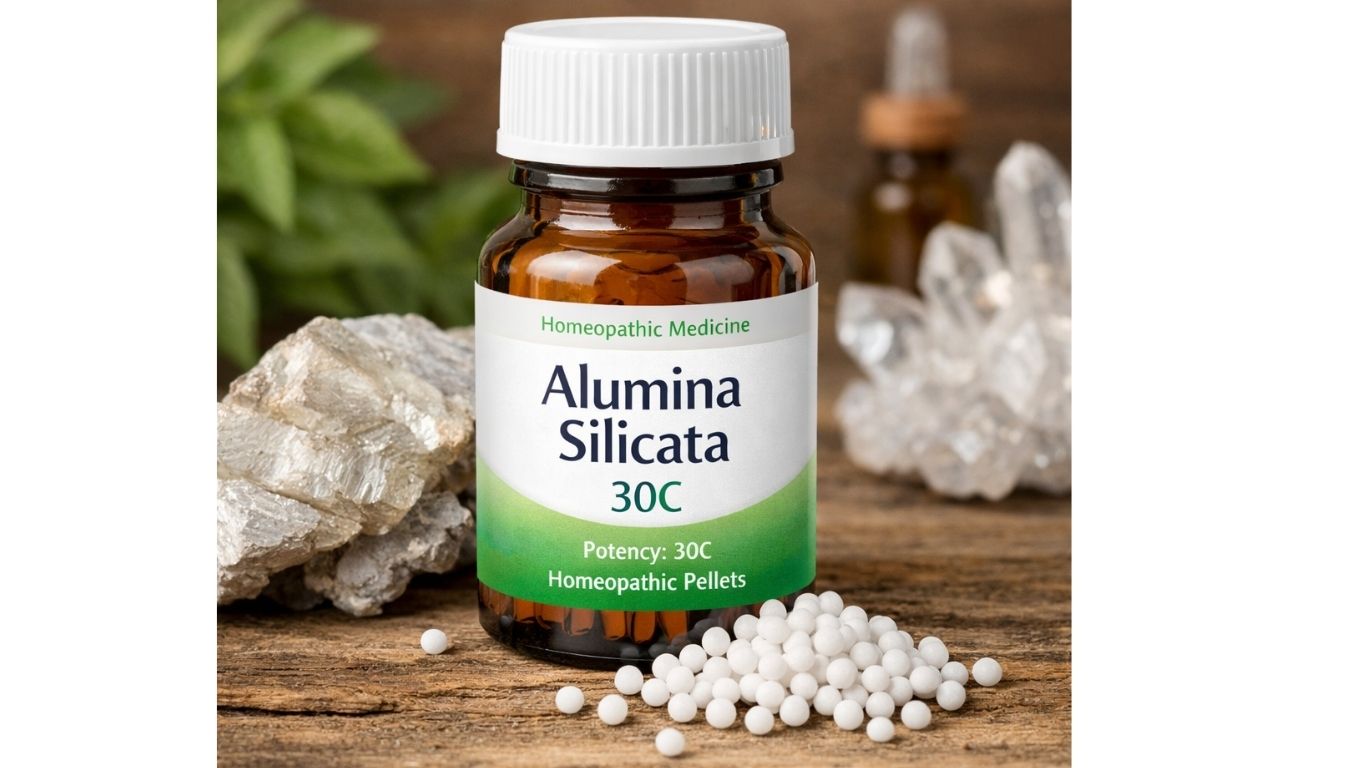
In the intricate and nuanced world of homeopathy, remedies are drawn from a vast spectrum of sources—mineral, plant, animal, and beyond. Among these, compounds born from the union of two fundamental elements of the earth’s crust hold a special place. Alumina Silicata, a dual-mineral remedy, stands as a profound testament to the homeopathic principle that the whole can be greater than the sum of its parts. It is not merely Alumina plus Silica, but a distinct therapeutic entity with its own portrait of healing.
Origin and Extraction: A Marriage of Earth’s Pillars
Alumina Silicata, as the name suggests, is a compound of alumina (aluminum oxide, Al₂O₃) and silica (silicon dioxide, SiO₂). In nature, this combination is most familiarly found in the form of clay, particularly varieties like kaolin. It is also a primary component of many precious stones and common rocks, forming the backbone of the aluminosilicate mineral class.
The homeopathic preparation adheres strictly to the principles of Hahnemannian pharmacy. The source material—often a purified clay or a synthesized compound—undergoes the process of trituration. This is a meticulous, hours-long grinding with lactose sugar to mechanically potentize the insoluble raw substance. Once rendered soluble through this process, it then undergoes the serial dilution and succussion (vigorous shaking) that defines homeopathic potentization. This process, homeopaths believe, imprints the energetic or informational pattern of the substance into the diluent while eliminating any toxicological material effects.
The remedy is thus born not from a chemical extraction of active ingredients, but from a dynamical preparation intended to capture the essence of the compound’s nature. It is this “energy blueprint” that is used in treatment, not the material molecule.
The Spectrum of Potencies: Choosing the Right Key
Like all homeopathic remedies, Alumina Silicata is available in a range of potencies, from low (e.g., 6C, 12C) to very high (e.g., 1M, 10M, CM). The choice of potency is a clinical art, deeply dependent on the individual case.
-
Low Potencies (6C – 30C): Often employed for more localized, physical symptoms or in situations requiring more frequent repetition. They might be considered for acute flare-ups of chronic conditions, such as a sudden, wet cough in a constitutionally susceptible individual.
-
Medium Potencies (200C): This is a common range for addressing a clearer picture of the mind-body totality. When the characteristic mental and general symptoms of Alumina Silicata are present alongside physical complaints, a 200C potency may be selected for a deeper, more systemic effect.
-
High Potencies (1M and above): Reserved for treating deep-seated, constitutional issues where the mental-emotional portrait is vivid and predominant. These potencies are typically administered infrequently and under the guidance of an experienced practitioner, as they aim to catalyze a profound shift in the organism’s vital force.
The dosage regimen is never standardized; it is tailored to the patient’s sensitivity, the depth of the illness, and their individual response.
The Symptom Portrait: The Alumina Silicata Individual
Homeopathy treats individuals, not diseases. Therefore, understanding Alumina Silicata requires painting a picture of the person—and the pattern of dysfunction—it best suits.
Mental and Emotional Landscape:
The Alumina Silicata state is often one of profound mental confusion and forgetfulness. The mind feels foggy, woolly, and slow. There is a marked difficulty in finding the right words; thoughts seem to evaporate mid-sentence. This is coupled with a peculiar sense of duality or disconnection. They may feel as if there are two wills battling inside them, or have a sensation that their body or mind is not quite their own. Anxiety is often present, but it is a vague, free-floating anxiety that may be worse in the evening. Despite this inner turmoil, they can be yielding and gentle, yet suffer from a lack of vital heat and drive.
General Physical Characteristics:
A key general modality is aggravation from cold, damp weather. They are decidedly chilly patients, feeling the cold deeply and suffering when the weather is wet. Conversely, they experience amelioration from warmth—warm rooms, warm bedding, warm drinks. There is often a marked periodicity to their complaints, with symptoms recurring at regular intervals. Profound weakness and exhaustion, as if from a long illness, are common features.
Characteristic Physical Symptoms:
-
Respiratory System: A hallmark is a loose, rattling, wet cough with copious mucus, yet difficulty in expectorating. The chest sounds full, and the cough is often worse in cold, damp air and during sleep. It is a key remedy for chronic bronchitis or bronchial weakness in chilly, worn-out individuals.
-
Digestive System: Tendency toward loose, clay-colored stools or, conversely, constipation. There can be a sense of weakness and sinking in the abdomen.
-
Head and Noses: Persistent, thick, white or yellowish catarrh from the nose and post-nasally. Headaches that feel like a pressure or fullness, often associated with sinus congestion.
-
Skin: Unhealthy skin that is slow to heal. Ulcers that are painless but stubborn, with a tendency to develop on the heels or other pressure points.
-
Extremities: A notable symptom is coldness of the heels in bed, as if they are resting on a block of ice.
Therapeutic Uses and Clinical Applications
In homeopathic practice, Alumina Silicata is not prescribed for a diagnosed medical condition per se, but for the state of being that underlies a variety of conditions. Its primary action seems to center on reinforcing a weakened constitution, improving assimilation, and clearing catarrhal accumulations. Common clinical situations where its picture may emerge include:
-
Chronic Catarrhal States: Recurrent sinusitis, bronchitis, or otitis media with thick, white discharge, especially in individuals who are always catching colds in damp weather.
-
Debility and Convalescence: For patients who recover slowly from acute illness, remaining weak, mentally foggy, and prone to lingering coughs or catarrh.
-
Senile Decline: In elderly patients showing marked confusion, forgetfulness, physical weakness, and a general sinking of vitality, particularly with catarrhal complications.
-
Persistent, Wet Coughs: Especially in children or adults where the cough is loose and rattling but exhausting, worse at night, and associated with coldness.
Side Effects and the Homeopathic Aggravation
Within the homeopathic framework, the concept of “side effects” differs from allopathic medicine. As the remedy contains no material dose, pharmacological side effects are not expected. However, a well-known phenomenon is the homeopathic aggravation.
This is a temporary, often mild, intensification of existing symptoms following a well-selected remedy. It is seen as a sign that the vital force has been stimulated and is responding. In the case of Alumina Silicata, a patient might experience a brief increase in catarrh or a fleeting return of an old symptom. Such aggravations are typically short-lived and followed by improvement. An aggravation of new or severe symptoms suggests the remedy was incorrect. This underlines the importance of professional guidance in homeopathic treatment.
Prevention: A Constitutional Approach
Homeopathy’s preventive role is constitutional. A deeply acting, well-prescribed remedy like Alumina Silicata, when it matches an individual’s fundamental state, aims to increase resilience. By addressing the underlying susceptibility—the tendency to catch every cold, the weak respiratory mucosa, the sluggish metabolism—it seeks to “tighten the ship,” making the individual less prone to frequent, recurring illnesses. It is not a vaccine against a specific pathogen, but a strengthening of the terrain, in alignment with the old adage, “The seed is nothing, the soil is everything.”
Comparative Analysis with Key Remedies
Distinguishing Alumina Silicata from its component parts and similar remedies is crucial for accurate prescription.
-
Vs. Alumina (pure Aluminium oxide): Both share mental confusion, sluggishness, and chilliness. However, Alumina’s confusion is more profound, with a stronger sense of identity loss and a keynote constipation with no urge whatsoever. Alumina is drier, more parched (constipation, dry mucous membranes), while Alumina Silicata is wetter, with copious catarrh. Alumina’s anxiety is more focused on health (hypochondriasis).
-
Vs. Silica (pure Silica): This is the most important comparison. Both are chilly, weak, and have suppurative processes (Silica is prime remedy for abscesses, splinters). Both can have head sweats. But Silica is about containment and expulsion. It is for the timid, finely-built person who lacks grit, with infections that localize (boils, abscesses) but then fail to resolve, needing to “push out” a foreign body. Alumina Silicata’s weakness is more profound, with more mental fog and less of Silica’s acute, localized pus formation. Silica’s discharges are more typically thin, yellow, and offensive.
-
Vs. Pulsatilla: Both have thick, bland, yellow or white catarrh. But Pulsatilla is changeable and warm-blooded. The Pulsatilla person is weepy, clingy, craves sympathy, and is markedly better in open air. Alumina Silicata is confused, detached, chilly, and worse in open, damp air. Their emotional tones are distinct: Pulsatilla’s is soft and yielding with a need for comfort; Alumina Silicata’s is vague and disconnected.
-
Vs. Calcarea Carbonica: Both are chilly, slow, and prone to catarrh and sweats (especially head). Calcarea is more solid, sturdy (though flabby), with a focus on security, routine, and anxiety about poverty or misfortune. Their catarrh and glandular swellings are more persistent and hard. Alumina Silicata’s confusion and sense of duality are less prominent in Calcarea.
Frequently Asked Questions (FAQs) About Homeopathic Medicine Alumina Silicata
1. What exactly is Alumina Silicata, and where does it come from?
Alumina Silicata is a homeopathic compound remedy prepared from a combination of alumina (aluminum oxide) and silica (silicon dioxide). Its natural source is most commonly clay, such as kaolin. In homeopathy, it is not used as a physical clay poultice but is prepared through a specific process of serial dilution and potentization, which homeopaths believe releases the therapeutic energy of the substance.
2. What kind of person or symptoms is Alumina Silicata best suited for?
Homeopathy matches remedies to the whole person, not just a disease. The classic Alumina Silicata picture involves a person who is mentally foggy, forgetful, and feels disconnected or “spaced out.” They are extremely chilly, feeling worse in cold, damp weather and much better with warmth. Physically, they often suffer from persistent, loose, rattling coughs with lots of mucus, chronic catarrh (sinus or bronchial), profound weakness, and slow recovery from illness.
3. I have a wet, chesty cough. How do I know if it’s Alumina Silicata or a different remedy?
While several remedies address coughs, Alumina Silicata’s cough is very specific. It is typically loose, rattling, and full of mucus, but the person may have difficulty bringing it up. It is often worse in cold, damp air, at night, and during sleep. The key is to look for the accompanying symptoms: the person will feel very cold, exhausted, mentally slow, and likely have a history of recurring catarrhal issues.
4. How is Alumina Silicata different from plain Silica (Silicea)?
This is a crucial distinction. Both are for chilly, weak individuals. However, Silica is often for timid, fine-featured people who lack “grit.” It is the premier remedy for helping the body expel foreign things (like splinters) or pus from infections like abscesses or boils. Alumina Silicata, by contrast, presents with more profound mental confusion and a overwhelming sense of physical weakness and congestion, with a focus on copious, wet catarrh in the chest and sinuses rather than localized abscesses.
5. Can Alumina Silicata be used for memory problems or brain fog?
Yes, but in a specific context. Homeopaths consider it for memory loss and mental confusion when it is part of the larger remedy picture. This includes a slow, foggy mind, difficulty finding words, a feeling of duality, and it is coupled with the characteristic physical symptoms (chilliness, catarrh, weakness). It is not a standalone “brain booster” but is used when the mental state matches the entire constitutional profile of the remedy.
6. What potency should I use, and how often should I take it?
There is no one-size-fits-all dosage. Lower potencies (like 6C or 30C) may be used for more acute, physical symptoms and repeated more frequently (e.g., twice daily for a few days). Higher potencies (200C and above) are chosen for deeper, constitutional issues and are taken much less often, sometimes just a single dose, under the guidance of a professional. It is always best to consult with a qualified homeopath for personalized advice on potency and dosage.
7. Are there any side effects?
Because homeopathic medicines are highly diluted, they are not known for pharmacological side effects like conventional drugs. However, a temporary “homeopathic aggravation” can occur, where existing symptoms mildly intensify for a short period as the body responds to the remedy. This is seen as a positive sign of action. If new or severe symptoms appear, it indicates the remedy is incorrect and should be stopped.
8. Can I take Alumina Silicata while on other medications?
Homeopathic remedies are generally considered safe to use alongside conventional medications, as they work on a different principle. They are not known to interact chemically. However, you should always inform all your healthcare providers (both conventional and homeopathic) about every treatment you are using to ensure coordinated care.
9. Where can I buy Alumina Silicata, and is it regulated?
Alumina Silicata is available from homeopathic pharmacies, health food stores with a homeopathic section, and reputable online retailers. In many countries (like the U.S. under the FDA’s HPUS), homeopathic medicines are regulated as drugs, with standards for their production, labeling, and sale. Always purchase from a trusted source.
10. Can I use this remedy for prevention, like boosting immunity against colds?
In homeopathy, prevention is linked to constitutional treatment. If an individual’s fundamental, chronic state matches the Alumina Silicata picture—meaning they are always the first to catch a cold in damp weather and suffer with long-lasting catarrh—then a well-prescribed dose may help strengthen their overall constitution and reduce this susceptibility. It is not a general immune “shot” for everyone, but a targeted approach for a specific type of person.
Conclusion
Alumina Silicata emerges as a remedy of profound consolidation for a constitution that has become diffused, weakened, and bogged down by catarrh and cold. It is for the individual whose mind and body have lost their cohesive vitality, leaving them foggy, chilled, and burdened by a physicality that fails to support them. In the homeopathic materia medica, it serves as a grounding force, a remedy that seeks to knit together what has become undone, offering the strength of the very earth from which it is derived. As with all homeopathic practice, its successful application rests not on matching a disease label, but on recognizing the unique human landscape for which it is the perfect, resonant match.